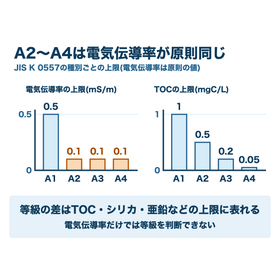
How is the purity of water referred to as pure water determined? This explains the guidelines for electrical conductivity and how to interpret the grades A1 to A4 defined by JIS K 0557.
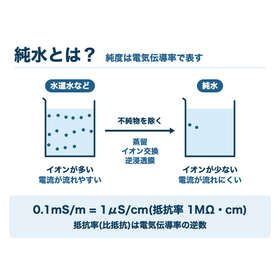
Pure water is water that has had impurities, such as ions found in tap water, removed through methods like distillation, ion exchange, and reverse osmosis. However, due to its wide range of applications, the required water quality is set according to its intended use. There are different standards for various fields, such as for analytical purposes and pharmaceuticals.
■ How is purity expressed?
The purity of pure water is generally expressed in terms of electrical conductivity or its reciprocal, resistivity (specific resistance). The fewer ions remain in the water, the less current can flow. Electrical conductivity is a continuous indicator of the remaining ions observed at the outlet of the device.
■ What standards are used to determine specifications?
The specifications for pure water not only include electrical conductivity but also set upper limits for items such as TOC (Total Organic Carbon). There are standards that classify the grades of pure water based on the differences in upper limits for each item. One such standard is JIS K 0557, which is introduced below.
■ Standards are not limited to domestic use
There are also international standards for reagent water, such as ASTM D1193 from the United States. Additionally, there are separate standards established by CLSI for water used in clinical testing. Please feel free to consult us first.